Custom Silk Robes: A Complete B2B Guide for Brands
Introduction
A custom silk robe can be much more than a traditional sleepwear product.
For sleepwear brands, fashion companies, bridal businesses, beauty brands, hotels, spas, gift companies, wholesalers, retailers, and e-commerce businesses, silk robes can become part of a premium sleepwear collection, bridal range, luxury gift set, beauty collection, or private label homewear line.
For B2B buyers, however, developing a custom silk robe involves much more than selecting a fabric and adding a logo.
A production-ready silk robe may need to be developed around:
100% Silk Fabric + Fabric Construction + Momme + Style + Length + Silhouette + Sleeves + Collar + Belt + Pockets + Color + Printing + Embroidery + Size + Branding + Packaging
Sinyoo Silk provides 100% silk robe OEM, ODM, and private label manufacturing for brands, wholesalers, retailers, designers, and e-commerce businesses.
This guide explains the key considerations when developing custom silk robes, from fabric selection and robe styles to garment construction, sampling, production, quality control, branding, and packaging.
Table of Contents
1. What Is a Custom Silk Robe?
A custom silk robe is a silk robe developed according to a brand’s specific requirements for fabric, design, sizing, construction, decoration, branding, and packaging.
Unlike a standard ready-made robe, a custom silk robe allows the buyer to control the main specifications of the finished product.
Customization can include:
- 100% silk fabric
- Fabric construction
- Momme weight
- Robe length
- Silhouette
- Sleeve design
- Collar design
- Front closure
- Belt
- Belt loops
- Pockets
- Piping
- Printing
- Embroidery
- Custom colors
- Custom sizing
- Labels
- Hangtags
- Packaging
For example, a luxury sleepwear brand may develop:
22 Momme Silk Satin + Long Robe + Contrast Piping + Embroidery Logo
A bridal brand may develop:
19 Momme Silk + Ivory Robe + Custom Embroidery + Branded Packaging
A fashion brand may choose:
Custom Printed Silk + Kimono Silhouette + Wide Sleeves + Matching Belt
The same silk robe category can therefore serve different markets and product positions.
2. Why Choose 100% Silk for Custom Robes?
100% silk is widely used for premium apparel, sleepwear, scarves, and luxury homewear.
For brands, silk can become part of the product positioning rather than simply a material specification.
Depending on the fabric and garment construction, custom silk robes can be developed for:
- Premium sleepwear
- Luxury homewear
- Bridal collections
- Beauty and self-care products
- Gift sets
- Fashion collections
- Boutique brands
- E-commerce collections
- Hotel and spa applications
Common characteristics of suitable silk fabrics can include:
- Smooth hand feel
- Natural luster
- Fluid drape
- Soft surface
- Lightweight construction
- Premium appearance
However, different silk fabrics can behave differently.
Therefore, B2B buyers should not specify only:
“100% Silk.”
A more complete specification can include:
Silk Fiber + Fabric Construction + Momme + Color + Finish
For example:
100% Mulberry Silk + Silk Satin Construction + 22 Momme
provides a clearer development direction.
The final fabric specification should be confirmed through a physical sample and technical specification before bulk production.
3. 100% Silk Fabric Options for Custom Robes
Different 100% silk fabrics can create different appearances, hand feels, structures, and drape.
| 100% Silk Fabric | Surface & Hand Feel | Drape | Typical Robe Application |
|---|---|---|---|
| Silk Satin | Smooth and glossy | Excellent | Luxury and premium robes |
| Silk Charmeuse | Soft, smooth and fluid | Excellent | Premium sleepwear |
| Silk Crepe de Chine | Fine texture, softer appearance | Good | Everyday premium robes |
| Silk Twill | More structured surface | Medium to good | Fashion and luxury robes |
| Silk Jacquard | Woven patterns and texture | Depends on construction | Statement and luxury robes |
| Silk Georgette | Lightweight and textured | Good | Lightweight robes |
| Silk Habotai | Lightweight and smooth | Soft | Lightweight sleepwear |
| Silk Velvet | Soft, rich and fuller | Fuller | Seasonal luxury collections |
One important distinction for B2B buyers is the difference between silk fiber and fabric construction.
Mulberry Silk describes the silk fiber source, while terms such as Satin, Twill, Jacquard, and Georgette describe fabric construction or structure.
They are therefore not always competing categories.
For example:
100% Mulberry Silk + Satin Construction
can be the specification of one fabric.
The final fabric should always be confirmed through the actual sample and technical specification because fabric names and constructions can vary between suppliers and markets.
4. How to Choose Momme for a Silk Robe?
Momme is an important specification for silk garments.
It refers to the weight of silk fabric and can influence the fabric’s body, opacity, drape, and overall feel.
A higher Momme does not automatically mean that a fabric is better for every robe.
The appropriate Momme depends on:
Fabric Type + Fabric Construction + Season + Design + Target Market + Budget
A general development reference is:
| Momme | General Direction | Possible Applications |
|---|---|---|
| 16 Momme | Lightweight and fluid | Lightweight and seasonal robes |
| 19 Momme | Versatile | Core premium collections |
| 22 Momme | Fuller and more substantial | Premium sleepwear |
| 25 Momme | Heavier and more substantial | Luxury and statement products |
| 30 Momme | Heavyweight | High-end and statement collections |
The appropriate Momme should be evaluated together with the actual fabric construction and finished garment.
For B2B development, the physical sample remains important because fabric weight alone does not determine the final appearance or performance of a robe.
5. Custom Silk Robe Styles
A custom silk robe can be developed in different silhouettes and product directions.
| Silk Robe Style | Main Features | Typical B2B Positioning |
|---|---|---|
| Long Silk Robe | Long silhouette, belt and classic collar | Premium sleepwear |
| Kimono-Style Silk Robe | Relaxed construction and wider sleeves | Fashion and lifestyle |
| Printed Silk Robe | Custom artwork or all-over print | Fashion and e-commerce |
| Embroidered Silk Robe | Logo, initials or decorative embroidery | Luxury and bridal |
| Bridal Silk Robe | Wedding-oriented colors and decoration | Bridal collections |
| Luxury Silk Robe | Premium fabric and refined construction | Luxury homewear |
| Custom Silk Robe Set | Robe combined with matching silk product | Premium and gifting |
The exact robe design can be developed according to the target market and brand identity.
6. Long Silk Robes
Long silk robes are one of the key product directions within custom silk robes.
Possible lengths include:
- Mid-calf
- Full-length
- Ankle-length
Brands can also customize:
- Body width
- Sleeve width
- Sleeve length
- Shoulder width
- Hem sweep
- Belt length
A full-length robe with wide sleeves may create a more dramatic silhouette, while a narrower silhouette can provide a cleaner and more minimal appearance.
For luxury sleepwear collections, brands may consider:
22–30 Momme + Long Silhouette + Premium Construction
as a development direction.
The final specification should be determined through sampling.
7. Kimono-Style Silk Robes
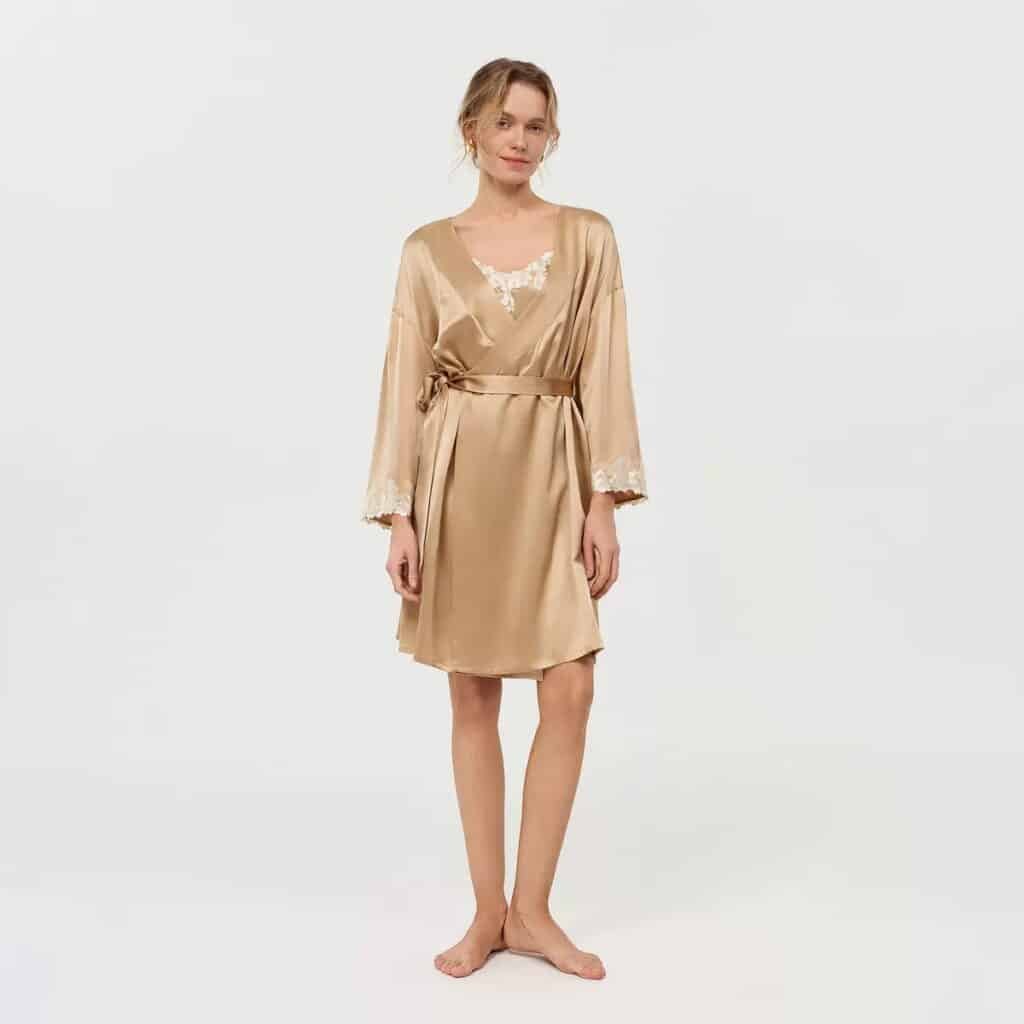
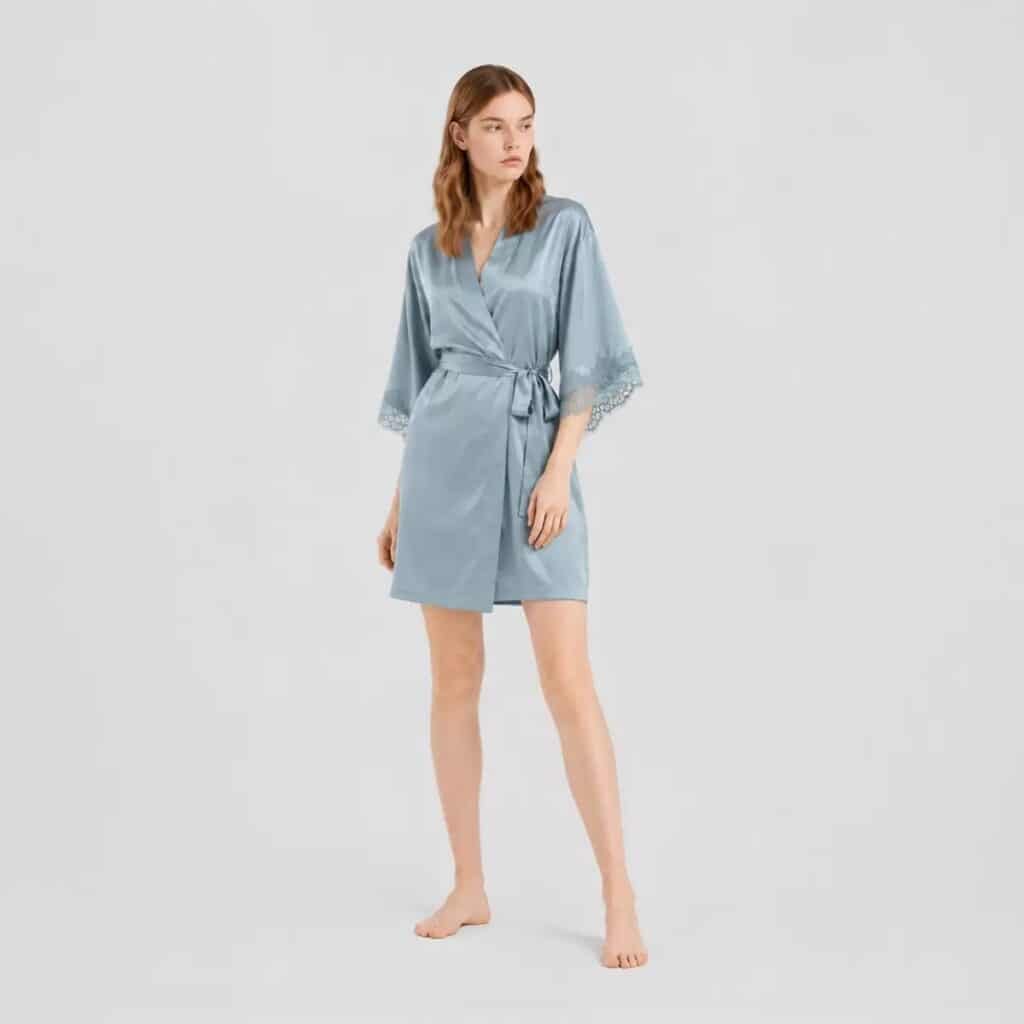
A Kimono-Style Silk Robe uses a more relaxed silhouette and can feature wider sleeves and a wrap-style front.
Possible customization includes:
- Sleeve width
- Sleeve length
- Collar construction
- Body width
- Robe length
- Belt width
- Belt loops
- Printing
- Embroidery
Kimono-style robes can be particularly suitable for:
- Fashion brands
- Lifestyle brands
- Beauty collections
- Bridal collections
- Gift products
Custom printed silk can also be used to create stronger visual differentiation.
8. Custom Sleeves, Collars and Front Construction
Sleeve and collar design can significantly change the appearance of a custom silk robe.
Sleeve Options
Common directions include:
- Long sleeves
- Wide sleeves
- Kimono sleeves
- Relaxed sleeves
- Cuffed sleeves
- Narrow sleeves
Collar Options
Brands can consider:
- Shawl collars
- Kimono collars
- Simple collars
- Collarless designs
Front Closure
Possible constructions include:
- Open front
- Matching silk belt
- Internal tie
- Belt + internal tie
An internal tie can help keep the inner front panel positioned correctly while the outer belt provides the main closure.
For B2B development, the front construction should be evaluated together with the robe’s fabric, silhouette, and drape.
9. Belt, Belt Loops and Pocket Construction
The belt is one of the most recognizable details of a wrap-style silk robe.
Possible belt options include:
- Matching silk belt
- Contrast belt
- Wide belt
- Narrow belt
- Long belt
- Self-fabric belt
Brands can also customize:
- Belt loop position
- Belt loop width
- Number of belt loops
- Pocket size
- Pocket position
- Pocket shape
Pocket options can include:
- Side pockets
- Patch pockets
- Hidden pockets
Because belt loops and pocket corners can experience repeated stress, reinforcement should be considered during development.
Possible reinforcement approaches can include:
- Bar-tacking
- Internal stabilization
- Additional stitching
- Reinforced seam construction
The exact method should be selected according to the actual silk fabric and garment construction.
10. Silk Robe Seam Construction and Garment Quality
For a premium silk robe, internal construction is just as important as the exterior appearance.
Important areas include:
- Shoulder seams
- Side seams
- Armholes
- Sleeve seams
- Collar seams
- Pocket attachment
- Belt loops
- Hem construction
Because silk fabrics can be delicate and fluid, production should control:
- Stitch tension
- Stitch density
- Needle selection
- Seam allowance
- Edge finishing
- Fabric distortion
- Seam stability
Different silk fabrics may require different sewing approaches.
The appropriate construction depends on:
Fabric + Construction + Stitch Type + Machine + Product Requirements
For B2B buyers, the approved sample should demonstrate acceptable:
Appearance + Seam Quality + Strength + Comfort + Dimensional Stability
before bulk production.
11. Custom Silk Robe Printing
Custom printing can turn a basic silk robe into a distinctive brand product.
Possible artwork includes:
- Floral patterns
- Botanical designs
- Geometric patterns
- Monograms
- Logo patterns
- Seasonal artwork
- Custom illustrations
- Placement prints
- All-over prints
The printing development process should confirm:
Artwork + Fabric + Printing Method + Color + Scale + Placement + Sample
The actual fabric sample is important because the final appearance of artwork can depend on the silk construction and printing process.
For large-scale designs, buyers should check:
- Color appearance
- Pattern scale
- Pattern repeat
- Placement
- Alignment
- Fabric hand feel
A brand can also use the same artwork across multiple silk products, such as:
Silk Robe + Silk Slip Dress + Silk Pajama Set + Silk Eye Mask
This can create a consistent visual identity across a collection.
12. Custom Embroidery for Silk Robes
Embroidery is another option for creating a personalized silk robe.
Common applications include:
- Brand logos
- Initials
- Names
- Wedding text
- Decorative motifs
Possible locations include:
| Embroidery Location | Possible Application |
|---|---|
| Chest | Brand logo or initials |
| Sleeve | Small decorative logo |
| Cuff | Premium detail |
| Back | Larger decorative artwork |
| Small logo | |
| Belt | Personalized branding |
For luxury products, a simple approach such as:
Solid Silk + Minimal Logo Embroidery
can create a clean visual identity.
For bridal products:
Ivory Silk + Bride/Bridesmaid Embroidery + Custom Packaging
can create a coordinated wedding product.
The embroidery specification should be tested against the actual silk fabric to evaluate appearance and fabric stability.
13. Custom Colors for Silk Robes
Color is one of the most important visual elements in a private label silk robe collection.
Brands can develop:
- Black
- White
- Ivory
- Champagne
- Navy
- Pastel colors
- Seasonal colors
- Brand colors
- Pantone-matched colors
Brands can also use contrast details.
For example:
Ivory Silk + Black Piping
or:
Navy Silk + White Piping
A collection can be organized around:
Core Colors + Seasonal Colors + Limited-Edition Colors
This allows the same robe construction to be used across multiple product launches.
For custom-dyed silk, the final color should be evaluated against an approved color standard or sample before bulk production.
14. Custom Sizes and Pattern Development
B2B brands may have their own sizing systems and measurement standards.
Instead of simply selecting S, M, or L, brands can provide a complete size chart.
Important measurements may include:
| Measurement | Development Purpose |
|---|---|
| Bust | Body width and fit |
| Waist | Waist fit |
| Hip | Lower-body fit |
| Shoulder | Shoulder construction |
| Sleeve Length | Sleeve proportion |
| Robe Length | Overall silhouette |
| Belt Length | Wrap and closure |
| Sweep | Garment volume and movement |
Brands can provide:
- Size charts
- Tech packs
- Existing samples
- Product photographs
- Sketches
- Measurement specifications
For established products, a physical reference sample can also help communicate:
Fit + Construction + Proportion + Sewing Details
Pattern development should maintain the intended overall silhouette rather than focusing only on individual measurements.
15. Fabric Consumption and Cost Considerations
A custom silk robe can require a significant amount of fabric depending on its construction.
Actual fabric consumption depends on:
- Robe length
- Garment width
- Sleeve volume
- Size range
- Pocket construction
- Pattern direction
- Fabric width
- Print repeat
- Cutting efficiency
A full-length, wide-sleeve kimono robe may require more fabric than a shorter, narrower silhouette.
This can affect:
- Fabric cost
- Cutting cost
- Production cost
- Product weight
- Shipping cost
Some robe manufacturing references use approximately 2.5–3.5 linear meters as a general reference for certain robe constructions and fabric widths. This should not be treated as a universal consumption standard.
For accurate B2B costing, consumption should be calculated from the actual:
Pattern + Size Range + Fabric Width + Fabric Direction + Cutting Layout
rather than estimated from robe length alone.
16. Custom Silk Robes for Different B2B Markets
Custom silk robes can be developed differently depending on the target market.
| B2B Market | Product Direction | Possible Customization |
|---|---|---|
| Sleepwear Brands | Premium sleepwear collections | Fabric, Momme, color, piping |
| Fashion Brands | Fashion-oriented homewear | Prints, silhouette, special details |
| Bridal Brands | Bridal and bridesmaid robes | Ivory/white, embroidery, packaging |
| Beauty Brands | Beauty and self-care products | Logo, embroidery, gift packaging |
| Hotels & Spas | Luxury guest or spa products | Size, color, logo |
| Gift Companies | Premium gift products | Embroidery, sets, gift boxes |
| E-commerce Brands | DTC silk robe collections | Custom print, branding, packaging |
| Luxury Brands | Statement and limited collections | High-Momme silk, jacquard, embroidery |
Different B2B markets can therefore use the same basic silk robe category while developing different products.
17. Custom Silk Robe Sets
A custom silk robe can also be developed as part of a coordinated product set.
One important combination is:
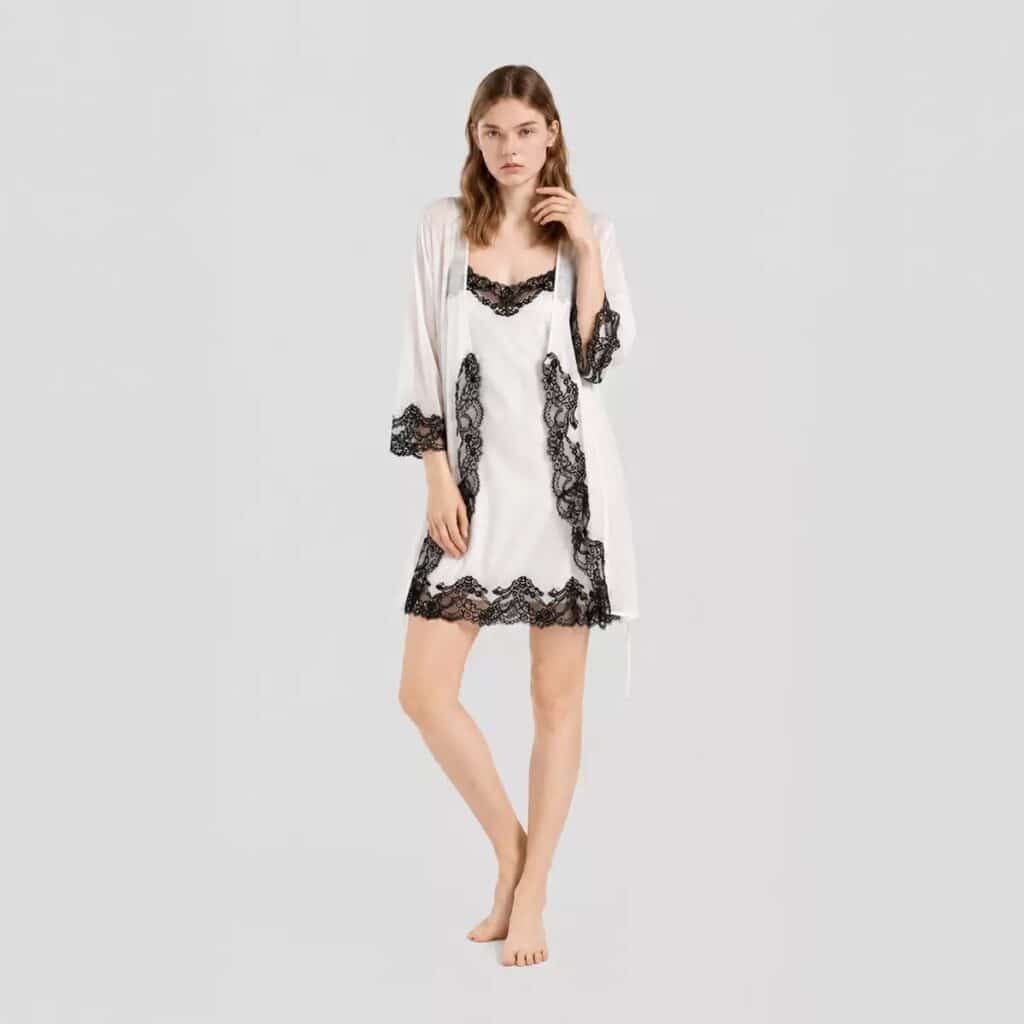
Long Silk Robe + Silk Slip Dress
Both products can use:
- The same silk fabric
- The same Momme
- The same color
- The same print
- Matching piping
- Matching branding
- Matching packaging
For example:
22 Momme Silk Satin + Long Silk Robe + Matching Silk Slip Dress
can become a complete premium sleepwear set.
Other matching products can include:
- Silk Pajama Sets
- Silk Camisole Sets
- Silk Slip Dresses
- Silk Eye Masks
- Silk Bonnets
- Silk Scrunchies
- Other 100% silk accessories
Brands can sell the products individually or as coordinated collections.
18. Custom Silk Robe Manufacturing Process
A professional B2B silk robe development process can be organized into the following stages:
| Stage | Main Work | Key Items to Confirm |
|---|---|---|
| 1. Product Brief | Define the product concept | Target market, positioning, quantity, target price |
| 2. Fabric Selection | Select the 100% silk fabric | Silk type, construction, Momme, width, color |
| 3. Design Development | Confirm garment design | Style, length, silhouette, sleeves, collar, belt |
| 4. Technical Development | Prepare specifications | Size chart, measurements, construction, tolerances |
| 5. Artwork & Branding | Prepare visual elements | Printing, embroidery, logo, labels, hangtags |
| 6. Pattern Development | Develop garment pattern | Measurements, proportions, fit, reference sample |
| 7. Sample Production | Make development sample | Fabric, color, fit, drape, workmanship |
| 8. Sample Approval | Review and finalize | Adjustments, measurements, final specifications |
| 9. Bulk Production | Manufacture approved product | Quantity, specifications, schedule |
| 10. Quality Inspection | Inspect finished products | Fabric, color, size, sewing, decoration |
| 11. Packaging | Prepare branded products | Bags, boxes, inserts, labels |
| 12. Shipment | Prepare goods for delivery | Cartons, shipping marks, logistics |
The overall development process can be summarized as:
Design → Fabric → Pattern → Sample → Approval → Bulk Production → QC → Packaging → Shipment
19. What Should B2B Buyers Check Before Bulk Production?
Before confirming a bulk order, procurement teams should review the complete product specification.
| Category | What B2B Buyers Should Confirm |
|---|---|
| Fabric | 100% silk, silk type, fabric construction, Momme |
| Fabric Width | Actual width and cutting requirements |
| Color | Pantone reference or approved color standard |
| Design | Final approved design |
| Style | Long robe, kimono style or other approved construction |
| Size | Size chart, measurements and tolerances |
| Length | Final robe length and proportions |
| Sleeves | Sleeve length, width and construction |
| Collar | Collar type and finishing |
| Belt | Belt length, width, loops and attachment |
| Pockets | Pocket size, position and reinforcement |
| Printing | Artwork, method, scale and placement |
| Embroidery | Logo, size, position and thread details |
| Branding | Main label, size label, care label and hangtag |
| Packaging | Bags, boxes, inserts and packaging details |
| Quality | Inspection requirements and approved sample |
| Production | Quantity, delivery schedule and shipping requirements |
Before bulk production, the following should be clearly confirmed:
Fabric + Color + Style + Size + Construction + Decoration + Branding + Packaging
The approved sample and confirmed technical specifications should serve as the main reference for bulk production.
20. OEM, ODM and Private Label Silk Robes
Different brands may need different levels of manufacturing and development support.
| Model | Brand Provides | Manufacturer Provides | Suitable For |
|---|---|---|---|
| OEM | Design, Tech Pack, Size Chart, Artwork or Reference Sample | Manufacturing according to approved specifications | Brands with established designs |
| ODM | Product concept, direction or requirements | Product development, fabric selection, pattern and sampling support | Brands developing new products |
| Private Label | Brand name, logo, labels and packaging requirements | Product manufacturing and private label preparation | Retail and e-commerce brands |
| OEM + Private Label | Finished design + branding requirements | Manufacturing + branding + packaging | Established brands |
| ODM + Private Label | Product concept + brand requirements | Development + manufacturing + branding | Brands launching new collections |
These models can also be combined.
For example:
ODM Product Development + OEM Manufacturing + Private Label Branding
can provide a complete product development solution from concept to finished branded silk robe.
21. How to Choose a Custom Silk Robe Manufacturer?
Choosing a manufacturer should involve more than comparing the lowest unit price.
A B2B buyer should evaluate the manufacturer’s ability to manage the complete product development process.
| Evaluation Area | What Buyers Should Check |
|---|---|
| 100% Silk Fabric | Silk types, construction and technical specifications |
| Momme Options | Available weights and consistency between sample and bulk |
| Fabric Sourcing | Ability to source or develop required silk fabrics |
| Product Development | Ability to develop designs and technical specifications |
| Pattern Development | Custom measurements, sizing and fit |
| Sampling | Sample development and adjustment capability |
| Garment Construction | Sewing, seams and reinforcement |
| Printing | Custom artwork and printing capability |
| Embroidery | Logo and decorative embroidery |
| Customization | Size, color, design and construction |
| Quality Control | Inspection process and quality requirements |
| Branding | Labels, hangtags and private label support |
| Packaging | Custom bags, boxes and branded packaging |
| OEM / ODM | Ability to work from designs or concepts |
| B2B Production | Sampling and bulk production capability |
| Product Range | Ability to develop matching silk products |
| Communication | Clear technical and production communication |
For a custom silk robe project, buyers should especially evaluate:
Fabric Quality + Sample Quality + Construction + Customization + Quality Control + Branding + Packaging
The goal is to establish consistency from the first sample through bulk production.
22. Develop Custom Silk Robes With Sinyoo Silk
Sinyoo Silk provides 100% silk robe OEM, ODM, and private label manufacturing for brands, wholesalers, retailers, designers, and e-commerce businesses.
A custom silk robe can be developed around multiple specifications:
| Development Area | Custom Options |
|---|---|
| Silk Fabric | Silk Satin, Silk Charmeuse, Silk Crepe de Chine, Silk Twill, Silk Jacquard, Silk Georgette, Silk Habotai, Silk Velvet and other suitable 100% silk fabrics |
| Momme | 16M, 19M, 22M, 25M, 30M and other development specifications |
| Style | Long robe, kimono-style robe, printed robe, embroidered robe and custom styles |
| Length | Mid-calf, full-length, ankle-length and custom proportions |
| Silhouette | Classic, relaxed, oversized, kimono-style and custom silhouettes |
| Sleeves | Long, wide, kimono, relaxed, cuffed and custom designs |
| Collar | Shawl, kimono, simple or collarless designs |
| Belt | Matching, contrast, wide, narrow and custom belts |
| Pockets | Side, patch or other custom constructions |
| Color | Brand colors, Pantone-matched colors, seasonal and custom colors |
| Printing | Custom artwork, placement printing, all-over printing and suitable printing methods |
| Embroidery | Logo, initials, names and decorative embroidery |
| Sizing | Custom size charts and measurements |
| Branding | Main labels, size labels, care labels and hangtags |
| Packaging | Custom bags, satin bags, gift boxes and branded packaging |
Brands can begin with a simple product concept or provide detailed development materials such as:
- Product photos
- Sketches
- Tech packs
- Size charts
- Reference samples
- Artwork
- Logo files
- Packaging designs
Sinyoo Silk can support the development process from:
Fabric Selection → Product Development → Pattern & Sampling → Sample Approval → Bulk Production → Quality Inspection → Packaging
Sinyoo Silk B2B Support
| Service | What It Covers |
|---|
| Fabric Development | 100% silk fabric selection and specification |
| Product Development | Design interpretation and garment construction |
| Pattern Development | Custom measurements, sizing and fit |
| Sampling | Pattern adjustment and sample production |
| Customization | Color, printing, embroidery, size and construction |
| OEM Manufacturing | Production based on approved specifications |
| ODM Development | Product development from concept to sample |
| Private Label | Labels, hangtags and branded packaging |
| Quality Control | Product inspection and production quality management |
| Product Expansion | Matching silk sleepwear and related 100% silk products |
Build a Complete Custom Silk Collection
A custom silk robe can become part of a larger silk product collection.
| Product Category | Matching Products |
|---|---|
| Silk Pajama Sets | Long-sleeve, short-sleeve and short-top & long-pants silk pajama sets |
| Silk Robes | Custom long silk robes and other custom robe styles |
| Silk Slip Dresses | Silk slip dresses and camisole dresses |
| Silk Camisole Sets | 2-piece silk camisole + shorts sets |
| Silk Accessories | Matching 100% silk accessories and gift products |
Brands can build a consistent collection around the same:
Silk Quality + Momme + Color Palette + Artwork + Branding + Packaging
Whether you are developing a classic long silk robe, printed kimono-style robe, bridal silk robe, embroidered silk robe, luxury high-Momme robe, or Long Silk Robe + Silk Slip Dress Set, Sinyoo Silk can support custom 100% silk product development for B2B customers.
To begin a custom silk robe project, brands can provide:
| Information to Send | Examples |
|---|---|
| Product | Custom silk robe / long silk robe / robe + slip dress |
| Fabric | Silk Satin / Charmeuse / Crepe de Chine / Twill / Jacquard |
| Momme | 16M / 19M / 22M / 25M / 30M |
| Design | Sketch, photo, Tech Pack or reference sample |
| Color | Pantone or color reference |
| Size | Size chart or measurements |
| Artwork | Printing or embroidery files |
| Logo | Logo file and placement |
| Packaging | Bag, gift box or custom packaging |
| Quantity | Estimated order quantity |
Sinyoo Silk — Custom 100% Silk Products for Brands
FAQ for Private Label Silk Robes
How Do You Prevent Belt Loops From Tearing Off Silk Robes?
Belt loops can experience significant pulling force during use, so their attachment needs to be designed according to the silk fabric and robe construction.
Possible reinforcement methods include:
- Dense bar-tacking
- Additional stitching
- Internal reinforcement
- Stabilization tape or suitable interfacing
- Reinforced attachment points
- Connecting the belt loop securely to a structural seam where appropriate
The exact construction should be tested on the actual silk fabric selected for production.
For B2B projects, buyers should inspect the approved sample and confirm that the belt loop attachment can withstand normal pulling and repeated use.
What Is the MOQ for Manufacturing Custom Silk Robes?
The MOQ for custom silk robes depends on the final product specifications.
Factors that may affect MOQ include:
- Silk fabric selection
- Robe design
- Custom colors
- Number of colors
- Number of sizes
- Custom dyeing
- Custom printing
- Embroidery
- Special silk fabrics
- Custom labels
- Custom packaging
- Total order quantity
For example, a standard solid-color silk robe may have different production requirements from a custom printed or embroidered luxury robe.
The final MOQ should therefore be confirmed after the product specifications are defined.
Are French Seams Necessary for Silk Robe Construction?
No. French seams are not required for every silk robe.
French seams can be suitable for certain lightweight silk fabrics because they enclose the raw fabric edges and create a clean interior finish.
However, the most appropriate seam construction depends on:
- Silk fabric type
- Fabric weight
- Robe design
- Seam location
- Garment construction
- Production requirements
- Desired interior finish
Depending on the design, other methods such as overlock seams, enclosed seams, or binding may also be appropriate.
The objective is to achieve a clean finish, stable seams, comfortable wear, and suitable durability for the selected silk fabric.
What Is the Purpose of Internal Modesty Ties on Wrap Silk Robes?
There is no universal fabric consumption figure for every silk robe.
Fabric requirements depend on several factors:
| Factor | Effect on Fabric Consumption |
|---|---|
| Robe length | Longer robes require more fabric |
| Sleeve design | Wider or longer sleeves increase consumption |
| Garment size | Larger sizes require more fabric |
| Silhouette | Relaxed or oversized designs may require more fabric |
| Pockets | Additional pattern pieces increase consumption |
| Belt | Requires additional fabric |
| Fabric width | Wider fabric can improve cutting efficiency |
| Print direction | Directional designs may increase fabric usage |
| Pattern repeat | Large print repeats can affect marker efficiency |
| Size range | Multiple sizes affect overall production planning |
As a general reference, 2.5–3.5 linear meters per robe may apply to certain robe constructions and fabric widths, but this should not be treated as a universal standard.
For accurate costing, fabric consumption should be calculated from the final pattern, size range, fabric width, pattern direction, and cutting layout.
How Much Fabric Yardage Is Required Per Silk Robe?
An Internal Modesty Tie is an additional fastening inside a wrap-style silk robe.
It helps keep the inner front panel in position and can:
- Reduce excessive opening of the robe
- Improve front-panel stability
- Help keep the robe securely wrapped
- Improve wearing comfort
- Create a cleaner appearance
The location and construction of the internal tie should be developed according to the robe pattern, fabric drape, and front-opening design.
For premium or luxury silk robes, internal ties can be considered as part of the garment construction rather than simply a decorative detail.
Share: